

What Addison Knows
On the death of “cringe culture” and the virtues of trying.

I saw Lana Del Rey earlier this month, up front in the standing section, smoking Vogue cigarettes and drinking iced strawberry daiquiris with a girlfriend, the first time I’d been drunk since the night I got married. A couple of days after the show, my girlfriend shared with me a video taken from another Lana concert, a row of fans down on their knees worshipping Del Rey like a sun god while she played ‘There’s a tunnel under Ocean Boulevard’. This didn’t surprise me, celebrity is, after all, our culture’s chosen idolatry. And seeing Lana live felt a little like attending a church service—the emotional pathos of shared song, the fleeting, rapturous feeling that we all belong to a shared human project. Still, on the Uber ride home my girlfriend and I weren’t talking about Lana, nor was it Lana I was still thinking about in the days after the concert. Our preoccupation was her supporting act, the TikTok turned fledgling pop star Addison Rae. It was Rae’s first stadium performance, and as she grinned and twirled and cooed her way through the set, one was struck by that delicious sensation of being literally not able to look away from a person. Lana is famously passive on stage, she seems to view live performance as a kind of necessary evil. Addison revelled in the exhibitionism. She absorbed the adoration of the crowd and then released it back to us, like a sponge being dunked in water then slowly wrung back out again. “I feel like we’re watching history,” I said to my friend, totally sincerely, as Rae did a series of mountain climbers in round-toe Louboutin heels. She reminded me of a young Madonna.
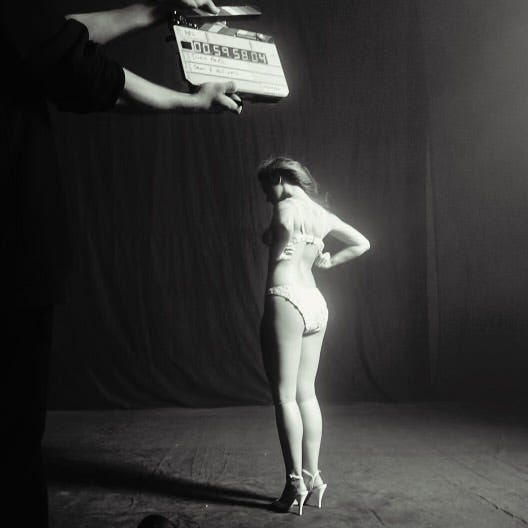
Like many people of a certain proclivity—TikTok agnostic, fashion adherent—Addison landed on my radar about a year ago, when she released ‘Diet Pepsi’, the first single from her debut album, Addison. The song was an assured, perfectly respectable pop outing but it was the accompanying music video that really marked her arrival as an artist. Directed by Sean Price Williams, best known for his collaborations with the Safdie Brothers, with creative direction from Mel Ottenberg, styling from Dara Allen, and creative consultancy by Lexee Smith, the video acted as a kind of proof of concept for the broader Addison project. It was audacious, seeking to place Rae in the pantheon of all-time greats: the lyrics were Lana-coded, the cheerleader cheerfulness was quintessential Britney, the cone bra evoked Madge. But she also announced her own brand of offbeat weirdness: the overt, boring sexiness undercut by a kind of goofy campness—the banana split, the hand down the tights, the Faster Pussycat! Kill Kill homage.
What became clear during the artful roll-out of her album was that Rae wasn’t curating a sound but an energy, a sensibility, a vibe. Addison is a succession of catchy earworms but Rae understood those songs wouldn’t amount to much—wouldn’t penetrate “the culture” in the way, say, her friend and collaborator Charli XCX did with Brat—without an accompanying aesthetic. Remarkably, especially when one considers old TikTok footage of Rae in her skinny jeans and crop tops, she managed to create one. In an era where the same references are endlessly refracted back to each other in a kind of bland, muted hall of mirrors, the Addison look, for which Lexee and Dara are particularly responsible, felt genuinely fresh. Rae in a hot pink wig, riding a horse bareback through the black salt flats of Iceland in the music video for ‘Headphones On’; the beige-accented dance break in ‘Aquamarine’; a pigtailed Rae cavorting in icing sugar for ‘High Fashion’—these will all, mark my words, enter the annals of pop culture iconography. And in Rae’s interview with Zane Lowe she confirmed this was her aspiration, that she wants to make music and visuals that people will still discover in ten, twenty, thirty years’ time. “The true value in an artist is knowing that the art extends past the day it was released… it can find you in any moment,” she said. Rae understands, having been on the front lines of our era’s war on attention, that longevity is now the ultimate aspiration, taking time to make something is chic, luxurious.
Rae’s goals are earnest and ambitious (she recently announced a desire to go by the mononymous Addison) and speak to a broader cultural trend toward po-faced sincerity. Millennial culture is defined by irony, apathy and an almost pathological aversion to “cringe”, the net result of a generation brought up on social media where self-awareness is a virtue and enthusiasm is quickly quashed. But this constant self-policing has started to feel oppressive. Last week Ocean Vuong spoke about the “unsettling cringe culture” that has permeated creative writing classes, stripping students of the bravery required to take artistic risks. It was into this climate that Timothée Chalamet’s earnest plea to become an “all time great” at this years’ Golden Globes landed, and why it hit such a cultural nerve. Six months’ later, Tyler, The Creator’s new record, Drop The Glass, was released, accompanied by a fervent note encouraging listeners to play the album on a dancefloor free of smartphones. “How much of our human spirit got killed because of the fear of becoming a meme?” he wrote. Rae, too, has long weathered accusations of being “cringe”. Her first single, the Benny Blanco-produced ‘Obsessed’, was roundly mocked when it was released (granted, it is a mere shadow of where she arrived with Addison). But Rae seemed impervious to the backlash. As she said in a recent interview, “embarrassment is an untouched feeling”. She sees shame as a kind of moral laziness, loser behaviour, as she suggested in her verse on the Charli XCX ‘Von Dutch’ remix. “I’m just living that life, while you’re sittin’ in your dad’s basement”. It’s a trite, overused clapback but the point still stands—who ever made an exceptional life for themselves without trying incredibly hard?
Of course the poster girl for trying is Madonna, who seems to be Addison’s great creative north star. In both artists' music one sees an unabashed desire for success, a hunger that is erotic in its intensity. Addison’s hypersexuality feels postmodern, or at least post-Pornhub. It’s wacky, weird, and so on the nose it almost becomes desexualised—I’m thinking of the abstract leg dance in ‘Aquamarine’, or the line in ‘High Fashion’, so ludicrous I spat my drink out laughing the first time I heard it: “You know I’m not an easy fuck, but when it comes to shoes I’ll be your slut”. The only thing Addison shows genuine desire for is her own reflection (she’s your dream girl but you’re not her type). This is a theme she picked up from Madonna, whose remarkable body of work doubles as a kind of great, epic novel charting the dizzying peaks and brutal heartbreaks of a life spent in relentless pursuit of greatness. We understand that the ‘you’ in ‘Hung Up’ is the royal ‘You’ of the audience. That’s who Madonna wants to seduce, who she can’t stop thinking about, who she’ll follows to the ends of the earth. To achieve that kind of success requires a heady dose of delusion, and both artists are evangelists of self-actualisation. Madonna’s first hit, ‘Lucky Star’, speaks of the talismanic qualities of good luck charms. Rae’s music is peppered with guru-ised manifestations: “Money loves me” “I’m the richest girl in the world”. And ‘Vogue’, of course, is nothing if not an anthem for the powers of delusion. “Your dreams will open the door”, Madonna declares, just like they did for a long list of American superstars: Marilyn, Rita, Greta, Fred.
There’s a moment in Truth or Dare, the documentary about Madonna’s 1990 Blonde Ambition tour, where Warren Beatty, Madonna’s then-boyfriend, mocks her obsession with fame. She’s resting her voice between shows, but breaks her protracted silence to speak to the filmmakers. “She doesn’t want to live off-camera, much less talk,” Beatty deadpans. “Why would you say something if it’s off-camera? What point is there existing?” (Beatty is being facetious here, but he actually feels this way too, he’s simply too self-conscious to admit it, which makes Madonna ultimately far cooler than him). To Madonna, it’s the glamorous life or no life at all. That’s how badly she wants it, that’s how much she cares, that’s how hard she tries. People forget now, with the luxury of distance, how cringe people found Madonna, how blatant her aspirations were, how visible the effort was. If TikTok existed in 1980 you can bet your ass Madonna—who, like Addison, left her small town with big dreams, who started her career as a dancer—would have had a TikTok account. You can bet your ass she would have been posting ten times a day. What Addison knows Madonna knew first, and Marilyn knew it before her, as did all those great one-named deities of our culture. That the pursuit of greatness is godly, an attempt at touching the immortal, at defying death. Every icon Madonna namechecks in ‘Vogue’ is now dead and buried, and yet they all, to a name, live on in our collective consciousness. Do you understand how good you have to be for us to hear the name Lauren and know it's followed by Baccall? The kind of sustained effort required to transcend time and space in that way? All those stars were first mocked, then grudgingly respected, and finally, wholeheartedly embraced. Addison knows that allegations of trying too hard are simply a sign she’s on the right path. On ‘Fame is a Gun’ she sings “I’m gonna go down in history … God gave me permission”. Watching her on stage at Wembley I felt sure He had.