

The Sue Tilley Interview
She sat for Lucian Freud and chronicled the life of her best friend, the late, great Leigh Bowery. Here, the iconic 'Big Sue' Tilley spills on her life at the centre of modern art in Britain.

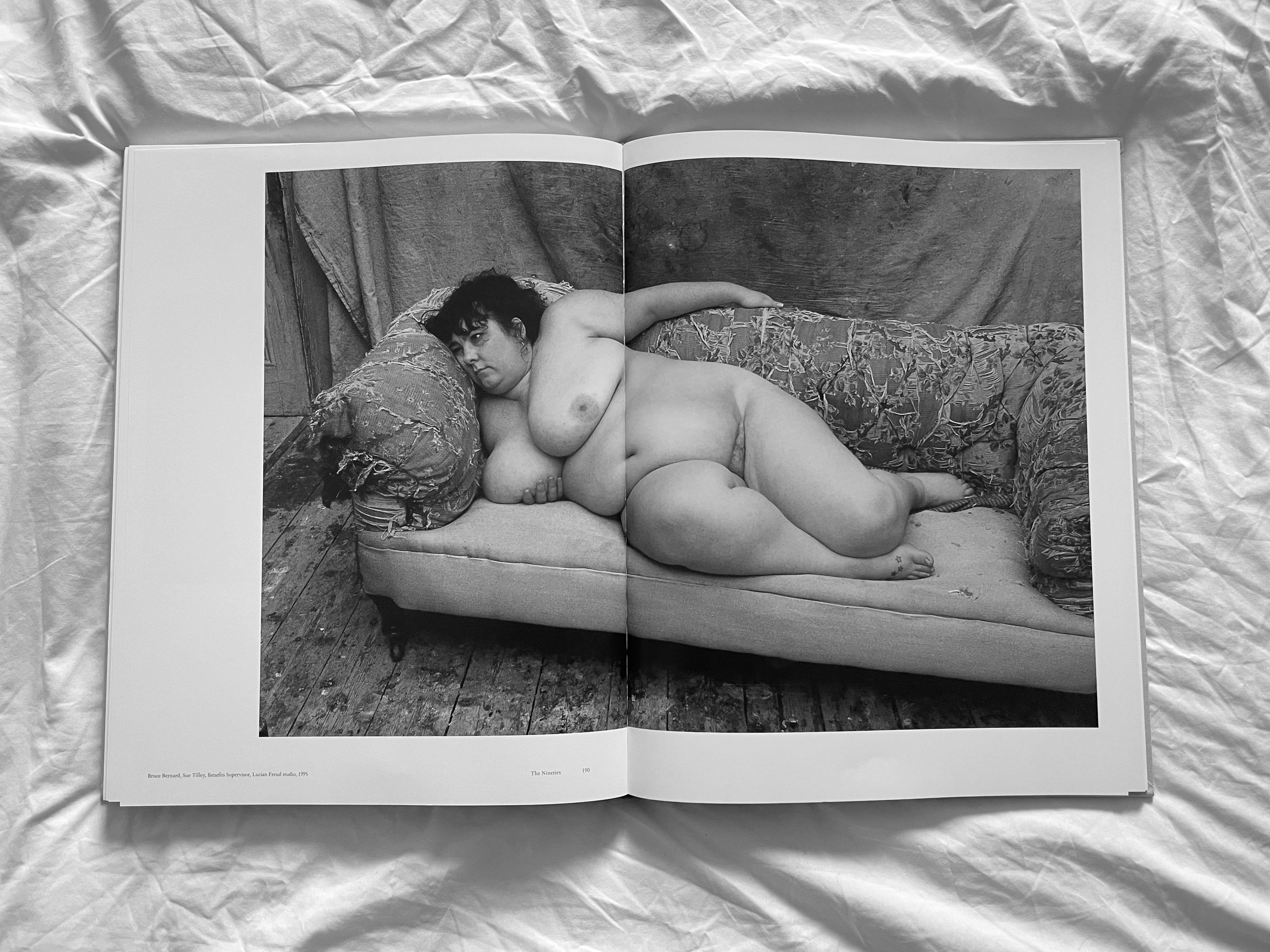
From ‘Lucian Freud: A Life’ Sue Tilley by Bruce Bernhard
In October 2022 I braved the crowds at Trafalgar Square to attend opening week of the National Gallery’s Lucian Freud retrospective. Queen Elizabeth II had died a month earlier, and the mass of attendees flocked to Freud’s postcard-sized portrait of the late monarch, which was guarded by a zealous employee tasked with enforcing the gallery’s ban on photos—a bizarre act of regal reverence. The portrait of Liz failed to stir me, what struck me instead, with a kind of physical, tangible blow, was the series of portraits in the exhibit’s final room, painted in the twilight years of Freud’s life. They depicted Leigh Bowery, the Australian-born London-based performance artist, and Bowery’s friend Sue Tilley. The paintings of Tilley, in particular, had a kind of mesmerising effect, glorious folds of human flesh, paint piled upon itself to create something almost three-dimensional. I later learned that one of these pictures, ‘Benefits Supervisor Sleeping’, sold for £17.2 million in 2008, which was, at the time, the highest price ever fetched for a work by a living artist. It placed Tilley, who sat for Freud while working as a benefits supervisor the Charing Cross Job Centre, firmly in the annals of modern art history.
Tilley crossed my path again this year when I read her biography of Leigh Bowery ahead of visiting his retrospective at the Tate Modern. Sue writes evocatively about her friend Leigh, a boy from Sunshine, Melbourne, who found himself at the epicentre of one of modern Britain’s most fertile creative milieus, alongside the dancer and choreographer Michael Clarke, the filmmaker John Maybury, the documentarian Charles Atlas, and the DJ Princess Julia. Bowery was a kind of undefinable creative polymath, a costume designer, musician and performance artist who has influenced generations of fashion designers, artists and drag queens, including Alexander McQueen, Rick Owens, Lady Gaga, and Marina Abramović. His club night, Taboo, is as legendary in England as Limelight was in New York City, populated during its brief 16-month existence by the likes of George Michael and John Galliano. Tilley, who befriended Bowery the year after he moved to London, was at Leigh’s side as he ascended the ranks of the British art and culture scene, and was by his side when he died suddenly of AIDS-related illness on New Year’s Eve 1994, aged just 33.
Tilley now lives in St. Leonards-on-Sea in East Sussex. In the years since Bowery’s death she has worked as an illustrator, collaborating with Fendi on a collection of accessories in 2017, but describes herself, gloriously, as totally lacking in ambition.
You’ve lived this exceptional life as a muse and collaborator of some of the most important artists of the last century. Did you love art as a child?
Oh yeah. We used to visit all the galleries, and my favorite thing was having drawing competitions with my sister. My mum had to judge us which was best and of course I always won because I was four years older than her and when you're eight and four that makes kind of a difference—I don’t think she’s ever recovered. I was the eldest of my cousins on both sides so I was always the oldest one and the bossiest one. But I had a lovely childhood, really. I’m always a bit bitter because people have all these problems in their childhood, but mine was perfectly lovely.
You first met Leigh Bowery when he had just moved to London and you clicked right away. What did you like about him?
We had very similar upbringings. He had a lovely childhood playing around with his cousins and had a nice family who took to exhibitions and things like that, like mine did. They were from the Salvation Army and my family were Church of England. I don't know. You know you just meet someone and straight away you're just really good friends? No one can really understand it or know why. That's just what happened.
Was there an immediate sense that he was destined for great things? Some people just have that glow…
He was always going on about when he was going to be famous. I didn’t hang around with him because I thought he was going to be famous, but he did have this kind of aura around him. You know he was only about six foot tall but people think he was gigantic because he had so much personality and charisma. It just poured out of him and made him seem even bigger than he was.
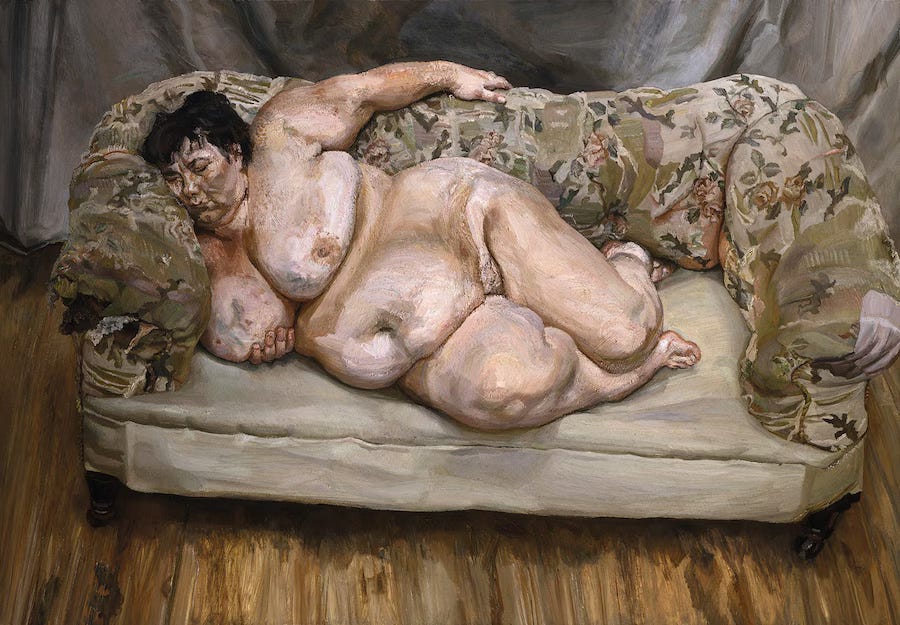
Benefits Supervisor Sleeping by Lucian Freud (1995)